First In, First Out: Rotating Tyre Stock With DOT Week-Year Codes
How to run first-in, first-out tyre stock with the DOT date code: read the week and year, log each batch, pick oldest first. A date code is not an expiry.
To rotate tyre stock first in, first out (FIFO), read the four-digit date code at the end of each tyre's DOT identification number. The first two digits are the week and the last two are the year. Record that week-year for every batch you receive, and always pick the batch with the earliest date first, size by size. A date code tells you when a tyre was made. It is not an expiry date: how a tyre ages depends on how it is stored and used.
This guide covers how to read the code, how to set up FIFO in a tyre warehouse, and what tyre makers say about storage and age.
How do I read the DOT week-year code?
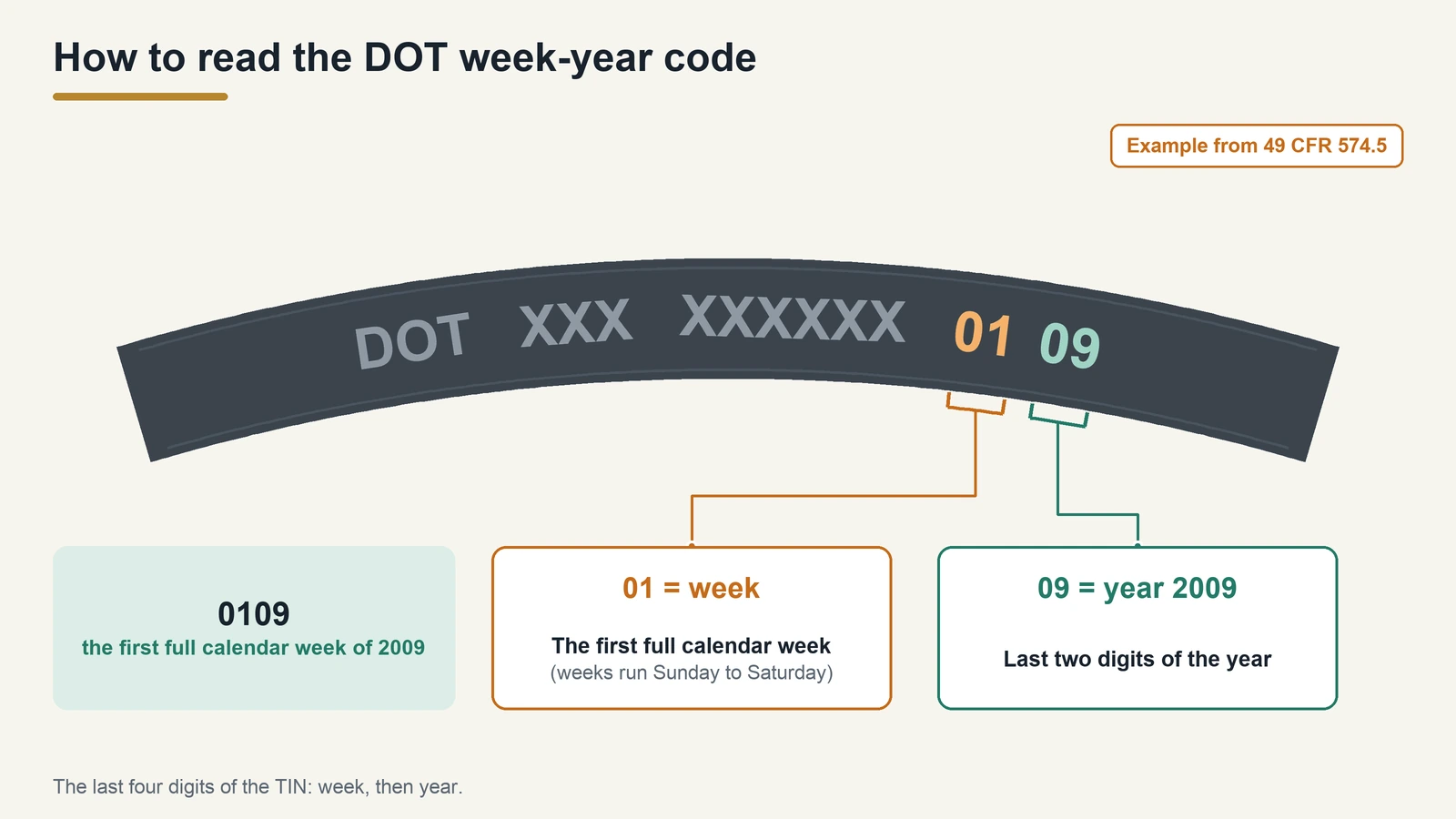
The date code is the last group of the tyre identification number (TIN) on the sidewall. Under US rule 49 CFR 574.5(b)(3), it has four digits:
Digits
Meaning
Example: 0109
1st and 2nd
Week of the year. "01" is the first full calendar week, and weeks run Sunday to Saturday
01
3rd and 4th
Last two digits of the year
09 = 2009
So 0109 means the first full calendar week of 2009. That is the regulation's own example. The US Tire Manufacturers Association (USTMA) gives another: 4510 is the 45th week of 2010.
On a new tyre the TIN has 13 symbols, and the date code is the last four. Continental notes that the date stamp "usually but not exclusively" follows the "DOT" marking. The TIN is required on one sidewall only, so check both sides.
If a tyre has no DOT TIN, ask the supplier where its production date is marked.
Why rotate tyre stock first in, first out?
Because tyre makers and their association advise it. USTMA's storage bulletin says "tires that have been in stock the longest period of time should be used first". Yokohama's storage bulletin gives the same advice and the reason: "The longer the storage period, the greater exposure there is to potential damage."
FIFO also makes your own records simpler. When every size moves oldest first, the stock on your shelves stays close in age.
How do I set up FIFO in a tyre warehouse?
Log the date code at receiving. For each pallet or batch, record size, pattern, TT/TL and the week-year code. Spot-check a few tyres per batch, because one shipment can contain more than one production week.
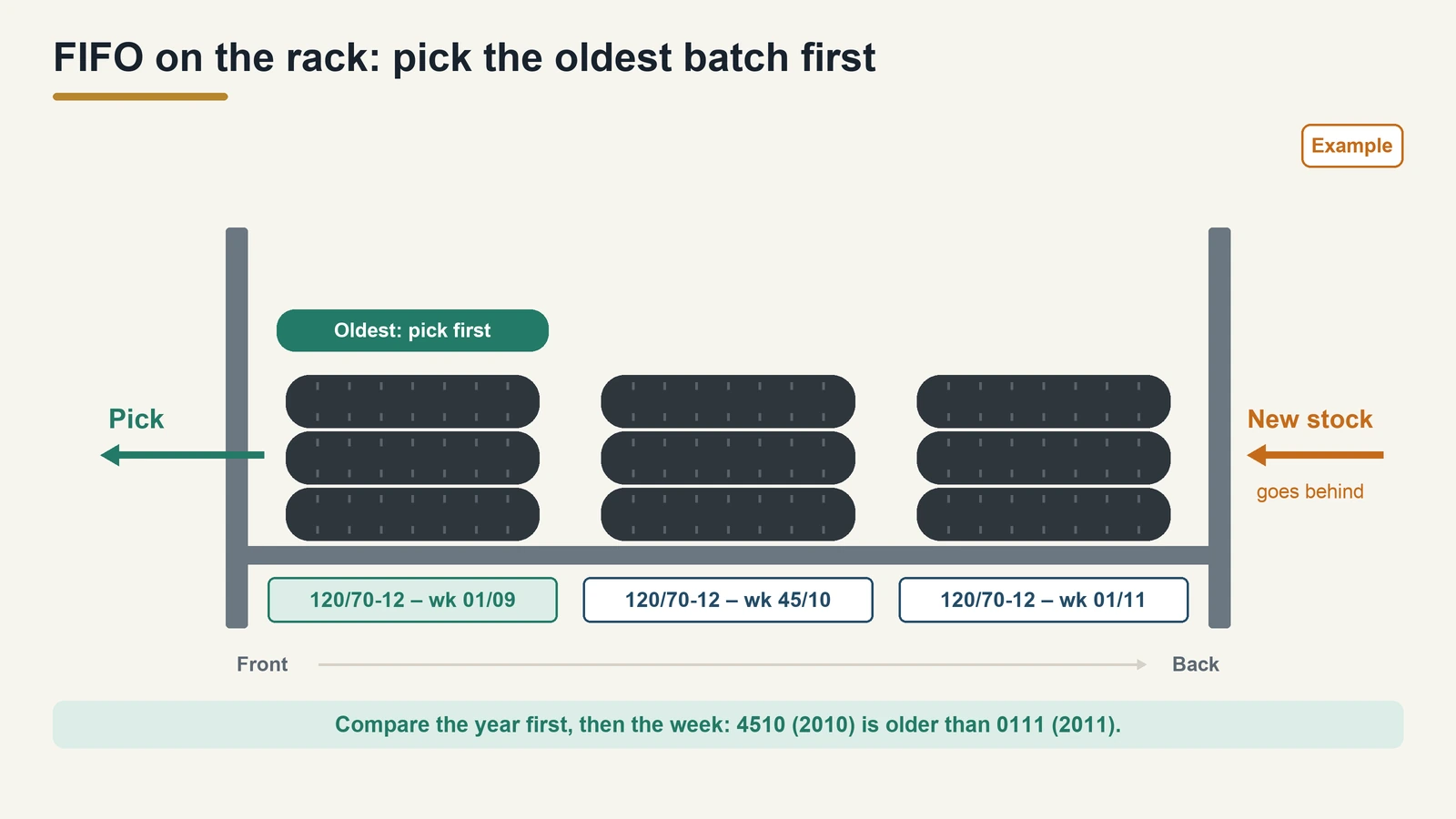
Label the location. Put the size and the week-year on the rack label, for example "120/70-12 – wk 01/09". Week first, then year, matching how the code is moulded.
Sort by year, then week. "4510" (2010) is older than "0111" (2011), even though 45 is bigger than 01. Compare the last two digits first.
Put new stock behind or below old stock. New arrivals go to the back of the bay or a new location, never in front of an older batch of the same size.
Pick by date, not by convenience. The picking list should show the oldest week-year for each size.
Review slow sizes. Once a month, list sizes where the oldest batch hasn't moved, and plan promotions or smaller reorders.
What storage conditions do tyre makers recommend?
Different makers publish slightly different lists, but the core points agree. Follow the instructions of the maker of the tyres you stock.
Point
What the source says
Source
Location
Indoors, "clean, dry and well ventilated, but with a minimum of circulating air"
USTMA bulletin
Light and temperature
"Mild temperatures, shaded or dark"; avoid "direct sunlight or artificial light with a high ultra-violet content"
USTMA; Continental
Ozone
Not "in the same area as an electric motor or other ozone generating sources"
Continental
Chemicals
Away from "solvents, fuels, oils, hydrocarbons, paint, acids"
Continental
Off the floor
Raised "on a pallet or a storage rack"; pallets with "a flat, smooth surface, not a grated surface"
USTMA bulletin
Stacking
"Do not over stack unmounted tires"; too much weight can damage the tyres at the bottom
USTMA bulletin
Motorcycle tyre temperature
"Not exceeding 35°C, preferably below 25°C"
Continental
USTMA adds that some specialty tyres, such as racing tyres, may need specific conditions, so check the maker's own recommendations.
Is the DOT date code an expiry date?
No. The date code shows the week and year of manufacture. It doesn't say when a tyre stops being usable. USTMA's motorcycle tyre guide puts it plainly: tyres "don't have an 'expiration date'", because operating conditions, storage conditions, sunlight, heat cycles and wear are the main factors.
Continental makes a similar point. It says ageing "occurs very slowly … only if the tire is stored properly", and that predicting the service life of a specific tyre in years "is not possible".
Some makers do publish age guidance for their own tyres. Continental, for example, recommends replacing its tyres that are over 10 years old by the date stamp. These are each maker's own rules. Read the guidance from the maker of the tyres you sell, and the rules of your market. We don't set a fixed age limit in this guide.
FAQ
What does 2523 mean on a tyre?
If it is the four-digit DOT date code, it means week 25 of 2023. The first two digits are the week and the last two are the year.
Which side of the tyre has the date code?
The TIN must be on at least one sidewall, so it may be on one side only. Check both sides.
Should I sell the oldest tyres first?
Yes. USTMA advises that tyres in stock the longest should be used first, and Yokohama gives the same advice.
How long can tyres stay in a warehouse?
There is no single answer. Ageing depends on storage and use conditions. Follow the age guidance of each tyre's maker and your market's rules.
Ask us about the sizes you stock
Motorcycle tyres and inner tubes are made by Qingdao Zhengya Rubber Industrial Co., Ltd., founded in 2011, and supplied in partnership with Qingdao Moonstar Vehicle Co., Ltd. Send your size list and ask us how the production date is marked on each size. Lead time is 20–30 days, with 30% deposit and the balance before shipment. When goods arrive, use our checklist for sidewall markings against the quotation, or start from our home page.
Sources
Source
URL
Checked
49 CFR 574.5(b)(3), date code: week and year of manufacture, example 0109 (eCFR)