Storing Tyres and Tubes in Hot Climates: Heat, Sunlight and Ozone in the Warehouse
How to store motorcycle tyres and tubes in hot, sunny climates: Continental's 35°C limit, shade, ozone from generators, and what to do in outdoor yards.
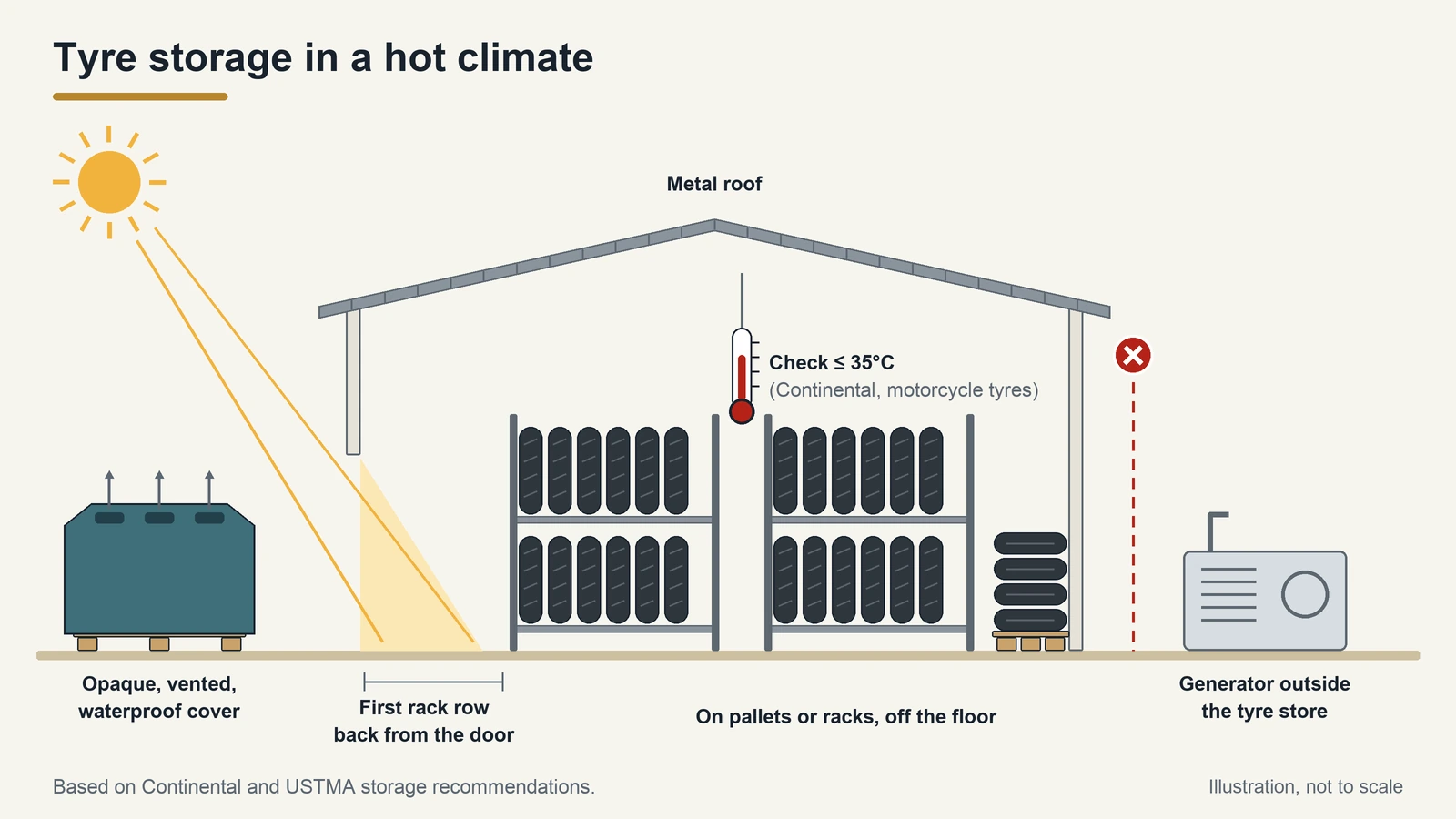
Keep motorcycle tyres indoors, in shade, off the floor and away from anything that makes ozone. Continental's storage advice for motorcycle tyres sets the temperature: "not exceeding 35°C, preferably below 25°C." In a hot climate, the work is mostly about meeting that: shade from the sun, distance from hot surfaces, and no generators in the tyre store.
This guide covers tyres first, then inner tubes, because the published advice we found is written for tyres.
Why do heat, sunlight and ozone matter for stored tyres?
Continental's storage page for motorcycle and scooter tyres starts with this: "Tyre compounds are formulated to resist deterioration caused e.g. by sunlight, humidity and ozone. Nevertheless, stored tyres should be protected against these and other potentially damaging conditions."
USTMA, the US tyre makers' association, says in its tyre storage bulletin: "Indoor storage is recommended to protect tires against environmental effects such as sunlight, ozone, and other potentially damaging conditions."
What temperature should a tyre warehouse stay below?
For motorcycle tyres, Continental's storage page says: "DO store all motorcycle tyres at temperatures not exceeding 35°C, preferably below 25°C."
USTMA's bulletin doesn't give a figure. It says to store tyres "in an area with temperate ambient conditions (mild temperatures, shaded or dark)" and not "in an area with extremely hot temperatures."
If your area gets hot, it helps to measure. Put a simple thermometer at the height of your top stack, where the air under a metal roof is usually hottest, and check it in the afternoon. If it reads above 35°C, the steps below are where to start.
How do I keep sunlight off stored tyres?
Both sources say no direct sun. Continental adds artificial light: avoid "direct sunlight or artificial light with a high ultra-violet content."
In practice:
Where sunlight gets in
What to do
Windows and skylights
Cover them, or keep racks out of the light path
Open loading doors
Keep the first rack row back from the door
Translucent roof panels
Shade the racks below them
Outdoor stacks
Opaque, vented cover (see below)
What surfaces should tyres not sit on?
Hot or reflective surfaces add heat and light. Continental says to avoid "black asphalt or other heat absorbent surfaces" and storing tyres "adjacent to highly reflective surfaces (i.e., sand or snow-covered ground)." USTMA says the same about asphalt and reflective ground such as sand.
USTMA also says to keep tyres "raised off the storage area's surface to minimize exposure to moisture or damage, such as on a pallet or a storage rack."
Can I store tyres outside if the warehouse is full?
Only covered. USTMA says not to store tyres "unprotected on piers, ship decks, open fields or other exposed outdoor areas."
If tyres must sit outdoors, both sources describe the same cover: opaque and waterproof, with ventilation. USTMA's wording is "an opaque, waterproof covering with some type of vent openings in order to avoid creating a 'heat box' or 'steam bath' effect." A sealed cover with no vents is what they warn against.
We'd treat tyres in a container waiting at a port or in your yard the same way, and unload them into shade as soon as you can.
Which equipment in a warehouse produces ozone?
USTMA lists "electric motors, battery chargers, generators, welding equipment, or other ozone-generating sources." Continental adds a level: "check ozone levels to be sure they do not exceed 0.08 ppm."
If you run a generator, keep it, and battery chargers and welding work, out of the tyre store. Continental also says: "NEVER store them near battery chargers, ovens or open fires."
Air conditioning is a cooling option, but Michelin notes, in its advice for bicycle tyres, that "some air-conditioners generate ozone." If you cool the store, check the unit with its maker.
How should inner tubes be stored?
We didn't find a tyre maker's published storage guide written for inner tubes. The advice above from Continental and USTMA is written for tyres, so we don't present it as a rule for tubes.
What we can tell you is how ours arrive: our tubes are packed in bags or cartons. Keeping them in that packing until sale, in the same shaded, cool store as your tyres and away from ozone sources, is a sensible default. Treat that as our suggestion, not a maker's specification.
Hot-climate warehouse checklist
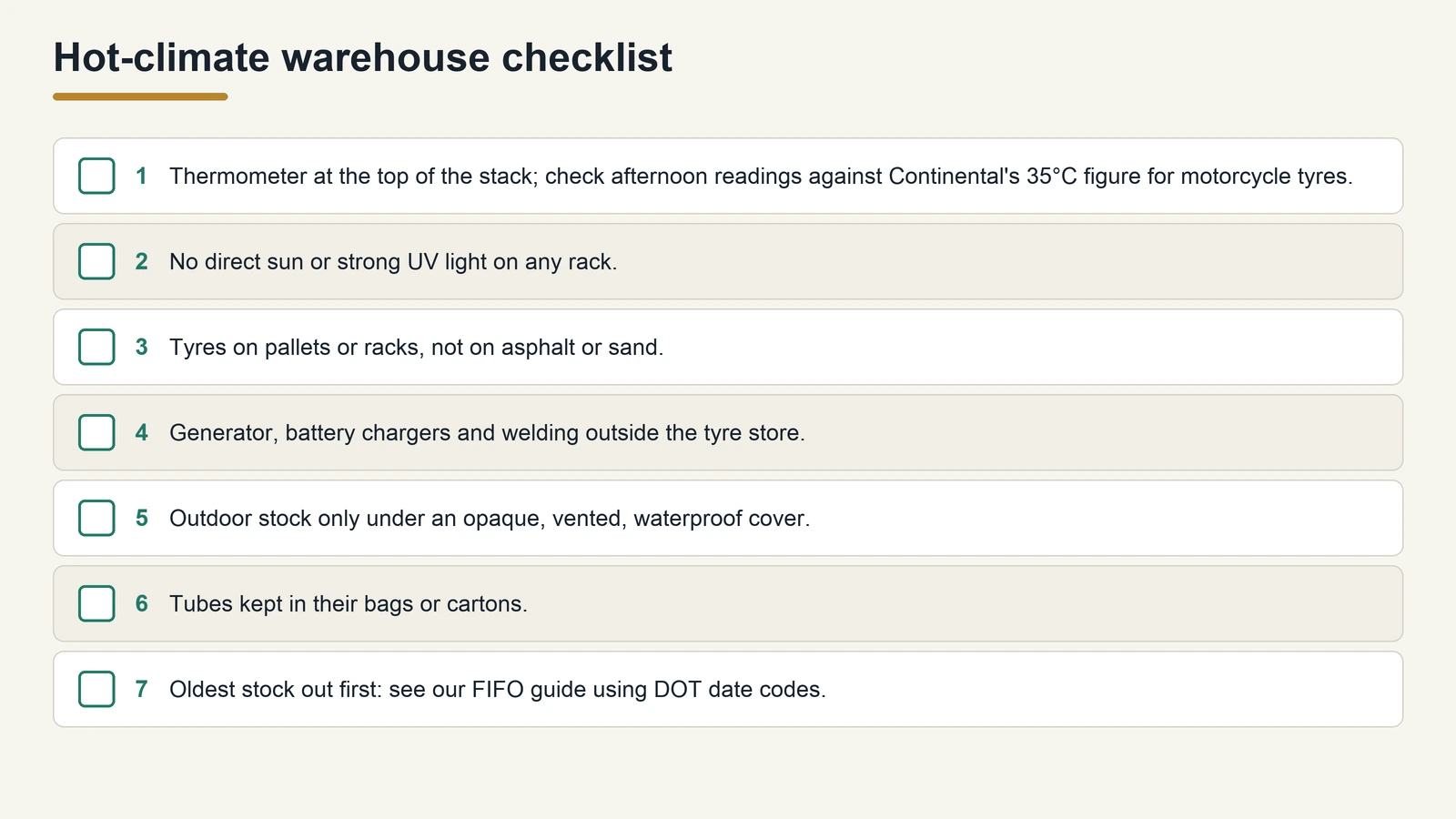
Thermometer at the top of the stack; check afternoon readings against Continental's 35°C figure for motorcycle tyres.
No direct sun or strong UV light on any rack.
Tyres on pallets or racks, not on asphalt or sand.
Generator, battery chargers and welding outside the tyre store.
Outdoor stock only under an opaque, vented, waterproof cover.
What is the maximum storage temperature for motorcycle tyres?
Continental's storage advice for motorcycle tyres says "not exceeding 35°C, preferably below 25°C." USTMA's bulletin gives no figure but says to avoid extremely hot areas.
Can I store tyres outside under a tarpaulin?
Only with an opaque, waterproof cover that has ventilation. USTMA warns against creating a "heat box" or "steam bath."
Does a generator damage tyres in storage?
USTMA lists generators among ozone-generating sources and says not to store tyres in the same area as them.
Do inner tubes need the same storage as tyres?
We didn't find maker guidance written for tubes. We suggest keeping them in their original bags or cartons, somewhere cool, shaded and away from ozone sources.
Ask about tyres and tubes
Moonstar works in partnership with Qingdao Zhengya Rubber Industrial Co., Ltd., maker of the tyres and tubes we supply. See our MS-R3 road and scooter tyres and MS-I1 inner tubes, or ask for a quote by size.