Which Markets Ask for E-mark? R75 and the 1958 Agreement
How tyre importers can check whether a destination applies UN Regulation 75: the 1958 Agreement, party declarations, and the national rule to confirm.
# Which Markets Ask for E-mark? UNECE R75 and the 1958 Agreement for Tyre Importers
"Do I need E-mark tyres for my market?" is a fair question, and a list of countries would be the easy answer. We are not going to give one. Whether a country recognises or requires a UN approval mark can change, and the answer for motorcycle tyres sits in that country's own rules.
What we can do is show you where the answer lives, how to read it, and what to ask your supplier for each size.
What the E-mark on a motorcycle tyre refers to
UN Regulation No. 75 (often written ECE R75) sets uniform provisions for approving pneumatic tyres for motorcycles. In its original text, published in the UN Treaty Series in 1988, the scope covers "new pneumatic tyres designed for highway use on motor cycles" and excludes, among others, tyres "designed only for off-the-road use and marked NHS". The regulation has been revised since then, so check the current version for its exact scope.
The same text describes the approval mark on the tyre:
"A circle surrounding the letter "E" followed by the distinguishing number of the country which has granted approval";
"The number of this Regulation, followed by the letter "R", a dash and the approval number".
So "E8 75R-001973" reads as: approved by the country with number 8, under Regulation No. 75, approval number 001973.
UN Regulations like R75 sit under an international treaty, usually called the 1958 Agreement. Its full title is the "Agreement concerning the adoption of harmonized technical United Nations Regulations for wheeled vehicles, equipment and parts…". It was done at Geneva on 20 March 1958 and entered into force on 20 June 1959.
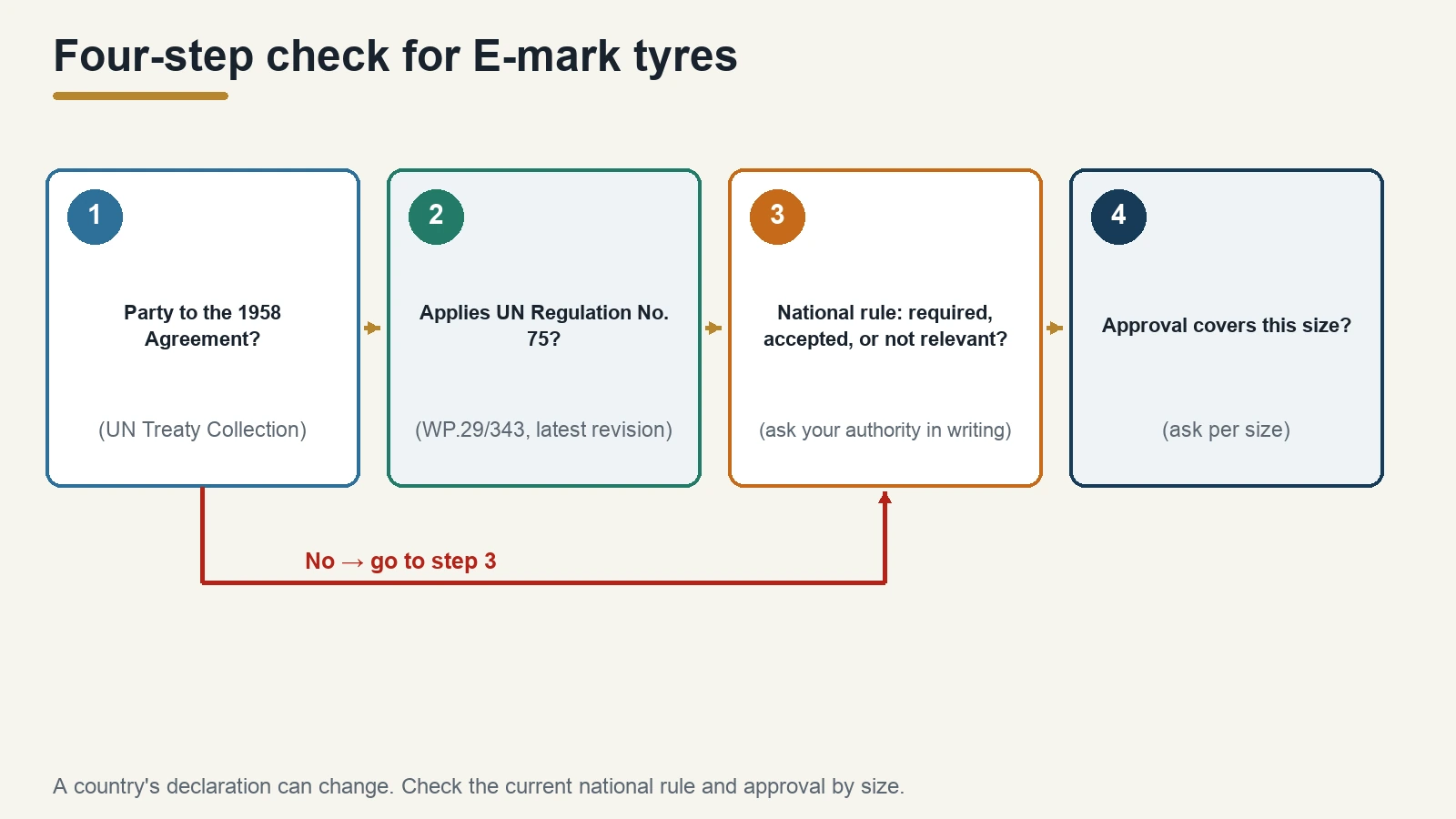
Step 1: Is the destination a party to the 1958 Agreement?
The United Nations Treaty Collection keeps the official status of the Agreement (Chapter XI, B-16). When we checked it on 5 November 2026, it listed 62 parties, including the European Union.
For importers in our markets, a few examples from that list are Egypt, Nigeria, South Africa, Tunisia and Uganda in Africa, and Pakistan and Türkiye nearby. Türkiye is also a good reminder for Step 2: its declaration says it does not consider itself bound by any of the annexed regulations. Many countries in Africa and the Middle East do not appear on the list.
If your country is not a party, the 1958 Agreement does not answer your question at all. Go straight to Step 3.
Step 2: Does it apply Regulation No. 75?
Being a party to the Agreement does not mean a country applies every UN Regulation. The same treaty page lists the declarations that parties made, and they vary a lot:
Andorra declared that it "accepts and shall apply" a short list of regulations, and No. 75 is on it.
Viet Nam declared that it "is not bound by any Regulations annexed to the Agreement".
Thailand declared that it "shall not be bound by any of the Regulations annexed to the Agreement, as amended, until further notification is given".
South Africa declared a list of regulations by which it "will not be bound".
These are declarations made when a country joined. A country can notify changes later, so the original declaration is not the last word. The UNECE secretariat publishes a consolidated document, "Status of the 1958 Agreement and of the annexed Regulations" (ECE/TRANS/WP.29/343), which shows which parties apply each regulation. Ask your customs broker or national authority for the current revision and look up Regulation No. 75 in it.
Step 3: What does the national rule say?
Even when a country applies R75, that tells you it recognises R75 approvals. It does not, on its own, tell you whether an R75 approval is the only way to import motorcycle tyres, one of several accepted routes, or required only for some vehicle categories. That is set by national law and the agencies that apply it.
Questions to put to your national standards body, type-approval authority or customs broker:
Are motorcycle tyres subject to a mandatory technical regulation or conformity scheme?
Is a UN R75 approval accepted, required, or not relevant to that scheme?
Is the requirement for every tyre imported, or only for tyres fitted to new vehicles?
Does the scheme ask for other marks, tests or documents in addition to, or instead of, R75?
Which document do they want to see: the approval certificate, the sidewall marking, or both?
Get the answer in writing, with the name of the regulation, before you plan a container around it.
Step 4: Check the approval per size, not per brand
An R75 approval belongs to specific sizes. A supplier "having E-mark" does not mean every tyre they make is approved.
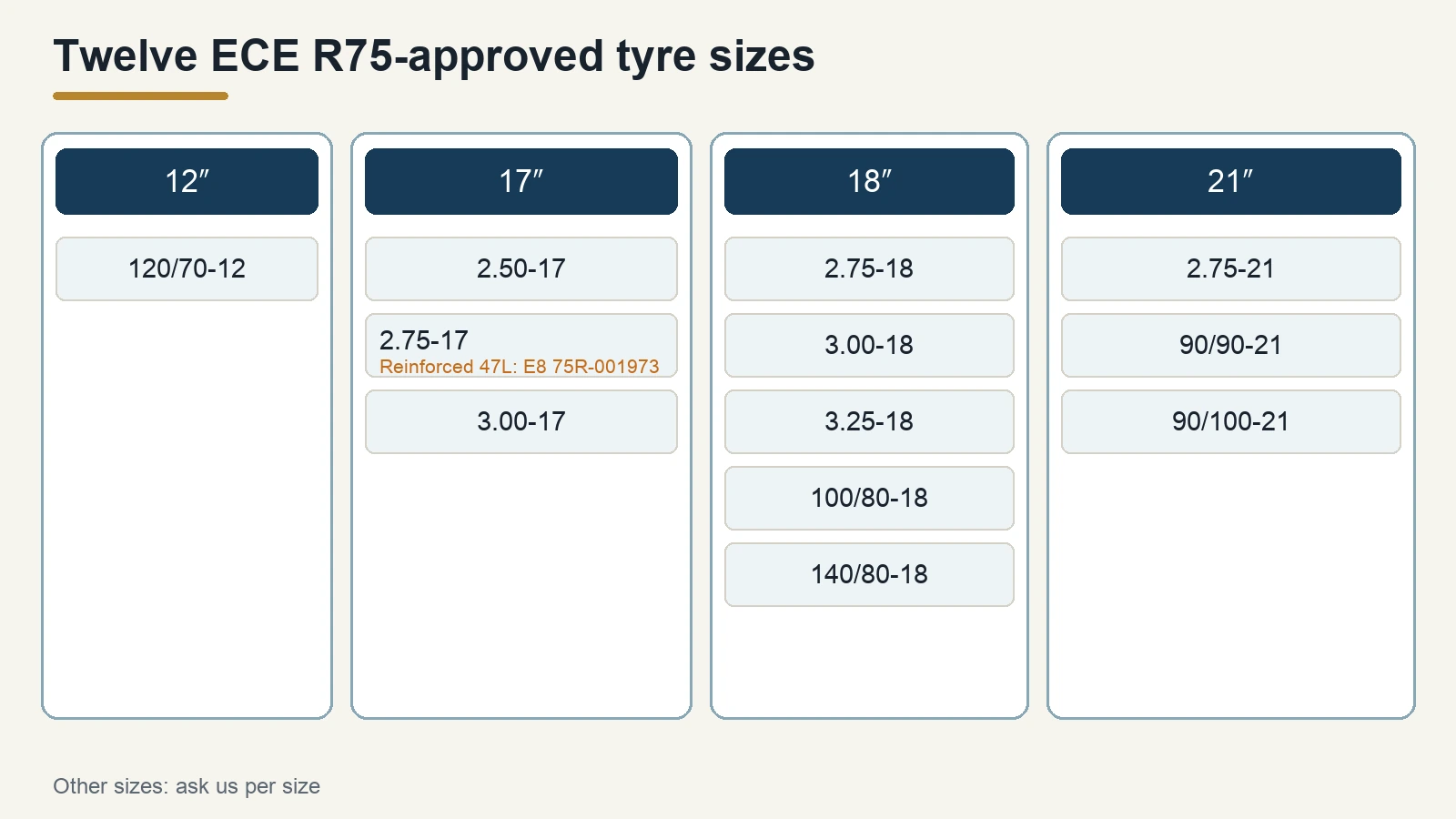
Our ECE R75 (E-mark) approvals cover these 12 sizes:
Rim
Sizes
12″
120/70-12
17″
2.50-17, 2.75-17, 3.00-17
18″
2.75-18, 3.00-18, 3.25-18, 100/80-18, 140/80-18
21″
2.75-21, 90/90-21, 90/100-21
For 2.75-17 Reinforced 47L, the approval is E8 75R-001973. More sizes are being added, so for any size outside this list, ask us per size. Certificate copies are available on request.
When you order, put the requirement on the order line, for example "2.75-18, pattern code, TT, E-mark required", so it is checked for that size and not assumed.
A short worked check
Example. An importer in Country X wants to sell 3.00-18 and 90/90-18 tyres.
Country X is on the UN Treaty Collection list. → Go on.
The current WP.29/343 shows Country X applies Regulation No. 75. → Go on.
The national authority confirms in writing that its motorcycle tyre scheme accepts R75 approvals. → R75 is a usable route.
On our list, 3.00-18 is covered; 90/90-18 is not. → Ask us about 90/90-18 before ordering it for that market.
Country X is invented. Only Step 4 uses real data.
FAQ
How many countries are in the 1958 Agreement?
The UN Treaty Collection status page listed 62 parties when we checked on 5 November 2026. The number changes as countries join.
If a country is a party, does it require E-mark tyres?
Not necessarily. Parties can declare which regulations they apply, and applying a regulation is not the same as making it the only way to import. Check the current WP.29/343 and the national rule.
What does "E8" mean on an approval?
Under R75, the number after the E is the distinguishing number of the country that granted the approval, and "75R" followed by digits is the regulation number and the approval number. Our 2.75-17 Reinforced 47L approval is E8 75R-001973.
Are all your tyres E-marked?
No. Our approvals cover the 12 sizes listed above. For other sizes, ask us per size.
Talk to us about your market
Send the sizes you plan to stock and what your authority has told you, and we will tell you which of those sizes are covered. Read how to check sidewall markings against a quotation, or contact Moonstar. Qingdao Moonstar Vehicle Co., Ltd. works in partnership with Qingdao Zhengya Rubber Industrial Co., Ltd., which makes these tyres.
Sources
Source
URL
Checked
United Nations Treaty Collection, Chapter XI B-16, Agreement concerning the adoption of harmonized technical United Nations Regulations… (title, Geneva 20 March 1958, entry into force 20 June 1959, "Parties: 62", status as at 05-11-2026, participant list, declarations of Andorra, Viet Nam, Thailand, South Africa, Türkiye)
United Nations Treaty Series, vol. 1500, A-4789: entry into force and text of Regulation No. 75 in its original form (scope; para. 5.4.1–5.4.2 approval mark; Annex 2 example)