Tube-Type or Tubeless Motorcycle Tyres: What to Stock
How tube-type and tubeless motorcycle tyres match spoke and cast wheels, why tyre makers' rules differ, and how a dealer can plan TT and TL stock.
If you sell motorcycle tyres, sooner or later a customer comes in with a tubeless tyre for a spoke wheel, or a tube-type tyre for a cast wheel. They want to know if it will work. The answer depends on the rim and on the tyre maker's own rules.
This guide covers how the main tyre makers describe the match between tyre and rim, where their rules differ, and how to turn that into a stock plan.
TT and TL: what the marks mean
The construction is marked on the tyre and written in the size description:
TT (tube-type): the tyre is made to be used with an inner tube.
TL (tubeless): the tyre is made to hold air without a tube on a suitable rim.
Michelin explains the difference simply. In a tube-type tyre, "the first layer of rubber on the inside is not airtight", so it "must therefore contain an inner tube". In a tubeless tyre, "the first layer of rubber is airtight".
Rims: spoke wheels and cast wheels
The tyre is only half of the question. The rim decides the rest.
Spoke wheels
Michelin says that on most spoke rims the spokes pierce the rim in the centre, and "since these holes imply a lack of sealing, this type of rim is Tube Type (TT)". It also notes that some spoke rims fix the spokes differently to keep the seal, and those rims are tubeless.
Continental describes tube-type rims (for example WM-type) as "usually used for spoked wheels".
So "spoke wheel" usually means a tube-type rim, but not always. Check the rim before you assume.
Cast wheels
Continental describes tubeless rims (for example the MT H2 type with safety humps) as "usually used for cast wheels". Michelin's guide says: "An Alloy rim is Tubeless (TL)".
Again, the word "usually" matters. The rim marking and the motorcycle maker's manual decide what that wheel takes.
Where tyre makers' rules differ
This is the part that causes most of the confusion at the counter. Two of the best-known makers say slightly different things.
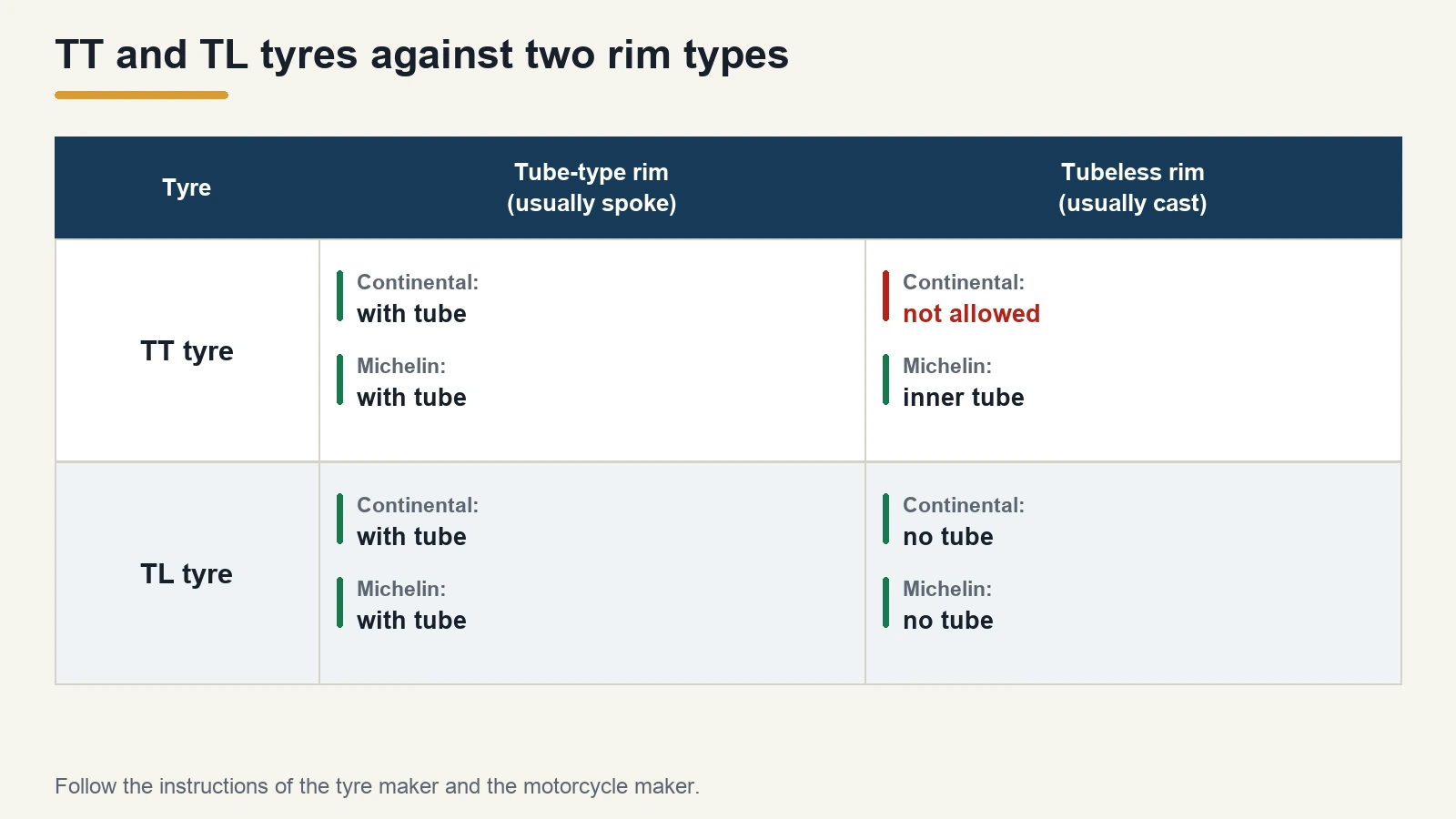
A tubeless tyre on a tube-type rim:
Continental says its tubeless tyres can be mounted on tube-type rims "if mounted with inner tubes of the correct size".
Michelin says the same in effect: with a TL tyre, "if the rim is TT, an inner tube must be used".
A tube-type tyre on a tubeless (cast) rim:
Continental says its tube-type tyres "are not allowed to be mounted on tubeless rims, neither with tubes nor without tubes".
Michelin's summary table lists an inner tube for a TT tyre on an alloy rim. That is one line in Michelin's own table, not a general approval for every tubeless rim: the motorcycle maker's wheel specification and the tyre maker's fitment rules still decide.
Tubes on tubeless rims:
Continental says "it is not allowed to mount tubes on tubeless rims".
Because the rules are not identical, the safe answer is to follow the instructions of the maker whose tyre you are selling, together with the motorcycle maker's specification for the wheel. Don't apply one brand's rule to another brand's tyre.
Rim bands for spoke wheels
When a tube goes into a spoke rim, the spoke heads sit under it. Michelin recommends a rim band, "a rubber accessory that covers the inner rim", to protect the tube from the spoke heads. If you stock tube-type tyres for spoke wheels, it makes sense to stock rim bands alongside them.
Turning this into a stock plan
You don't need a national statistic to plan TT and TL stock. You need your own sales records.
List the sizes you sell most, by front and rear.
For each size, note the wheel: spoke or cast. Use the bikes that actually come into your shop or your customers' shops.
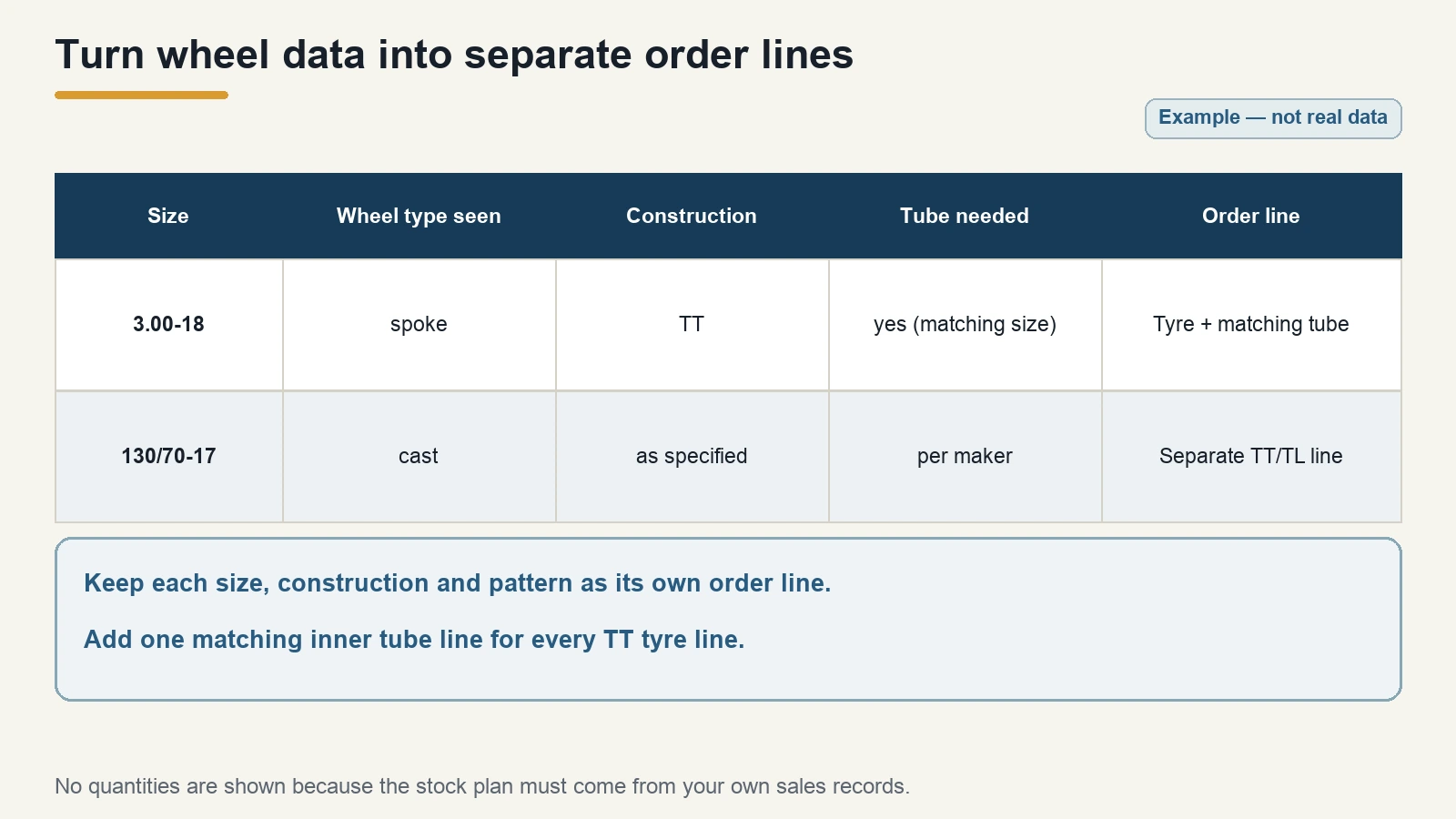
Split each size into TT and TL lines. A 3.00-18 TT and a 3.00-18 TL are two different products.
Add tubes for every TT line. One TT tyre sold usually means one tube sold, in the matching size. Note the valve type too.
Check minimums against your plan. Each size and pattern has its own minimum, so a TT and a TL version of the same size are two order lines.
Example (not real data): if your records show 3.00-18 mostly on spoke-wheel bikes and 130/70-17 mostly on cast-wheel bikes, the first order might be 3.00-18 TT plus matching tubes, and 130/70-17 in the construction the vehicle and tyre makers specify for that rim. The numbers come from your own sales, not from a rule of thumb.
What we can supply
Moonstar works in partnership with Qingdao Zhengya Rubber Industrial Co., Ltd.:
Tyres. Our tyre series cover commuter, road, scooter and off-road sizes, for example the MS-O1 series and the MS-A2 series. TT or TL is confirmed per size in the quotation.
Inner tubes. The MS-I1 series comes in natural rubber or butyl, and those sizes come with a TR4 valve.
On a tube-type spoke rim, Continental and Michelin both say a tubeless tyre needs an inner tube of the correct size. Some spoke rims are built to be tubeless. Check the rim and the tyre maker's instructions.
Can I put a tube-type tyre on a cast wheel?
Tyre makers differ. Continental does not allow its tube-type tyres on tubeless rims, with or without a tube. Follow the maker of the tyre you sell and the motorcycle maker's specification.
Do all cast wheels take tubeless tyres?
Continental says tubeless rims are "usually" used for cast wheels. Check the rim marking and the motorcycle manual for each model.
Should I stock tubes with tube-type tyres?
Usually, yes. Every TT tyre needs a tube of the matching size. For spoke rims, Michelin also recommends a rim band.
Is the minimum order per size or per construction?
Our minimum is 300 pieces per size and pattern. A TT and a TL version of the same size are separate order lines.
Ask for a quotation
Send your sizes, with TT or TL and the quantity per line, through our contact form.
Written by the Moonstar export desk. Product facts follow the manufacturer's documents; figures for your order are confirmed in the quotation.
Need a quotation?
Send your sizes, quantities and destination. We confirm MOQ, lead time, packing and documents for your market.